


Quote
Subtotal: $0
Views: 0 Author: Site Editor Publish Time: 2026-02-05 Origin: Site
In scenarios such as road transportation and engineering construction, trucks rely on strong power to carry massive loads and conquer complex road conditions, which is inseparable from a precise and efficient power system. It directly determines the vehicle's load-carrying capacity, fuel economy, and environmental performance, serving as the core support for trucks to realize transportation and operation functions. The following will detail the composition, core components, working principles, and common fault troubleshooting methods of the truck power system.
The power system is the core system that provides power for truck driving and operations. Its core function is to convert the chemical energy of fuel into mechanical energy to drive the vehicle forward, while supporting functions such as heavy load transportation and engineering operations. It is the foundation for trucks to realize their practical value.
A complete truck power system consists of key parts including the engine assembly, intake system, fuel system, cooling system, and exhaust system (including exhaust gas aftertreatment devices). Each system works collaboratively to ensure stable power output and efficient operation.
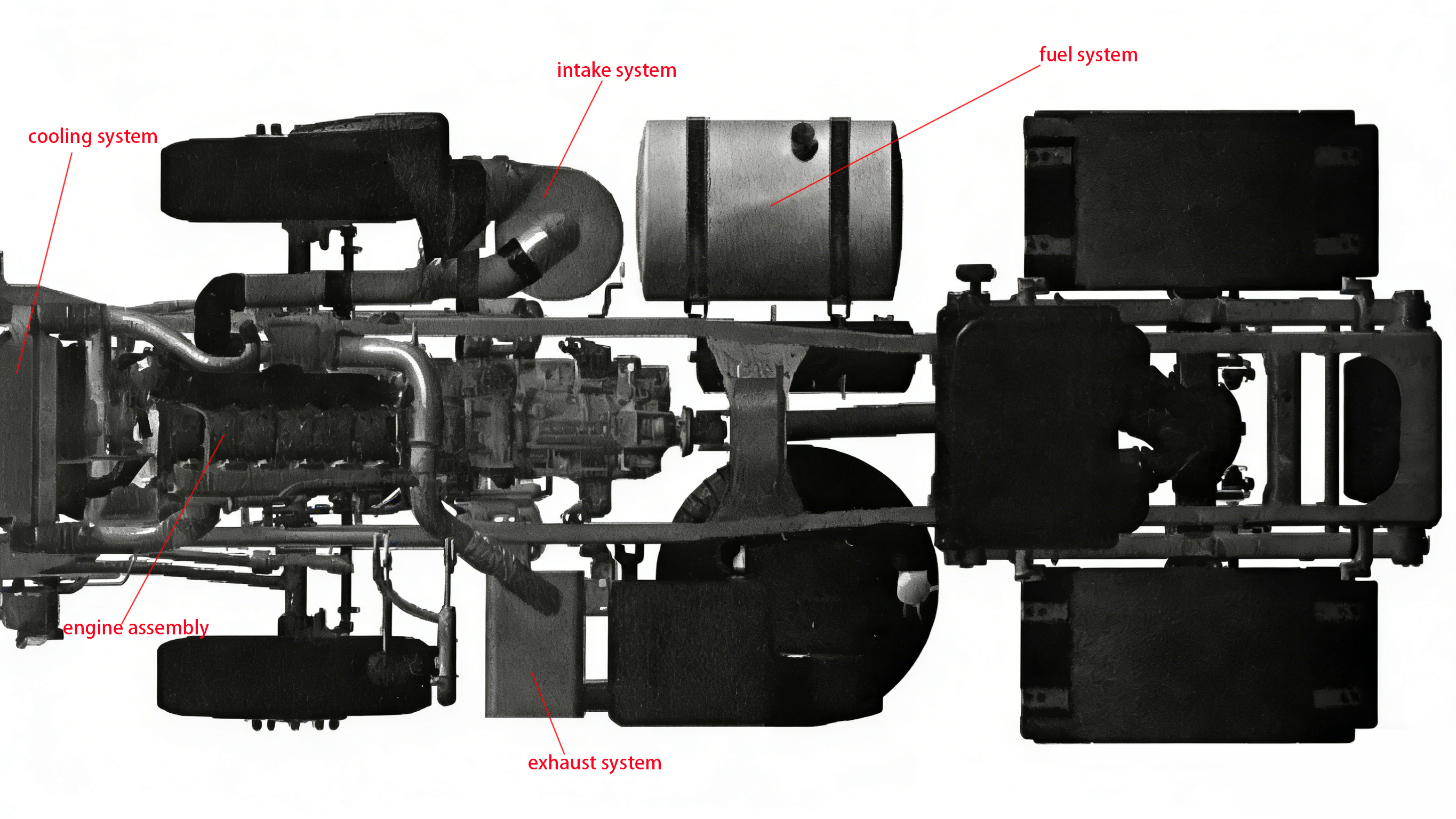
The engine assembly is the core of the power system and the sole source of vehicle power, usually installed at the front of the vehicle. Essentially, it converts the internal energy generated by fuel combustion into mechanical energy to drive the truck.

· By fuel type: Mainly diesel engines and gasoline engines. Diesel engines have a high compression ratio and thermal efficiency, with better emission and economic performance, making them the mainstream choice for commercial vehicles. Gasoline engines have high rotational speed, small size, and easy startup, and are only used in some light commercial vehicles.
· By cylinder arrangement: Common types include inline (L-type), V-type, W-type, etc. Engines with six cylinders or fewer mostly adopt an inline layout, featuring a compact structure, low cost, and easy supercharger installation. Engines with eight cylinders or more are mostly V-type layouts, suitable for high-power requirements.
· By supercharging method: Divided into supercharged (forced induction) and naturally aspirated (non-supercharged). Supercharged engines increase intake pressure through a supercharger, which can significantly improve engine power and has become the mainstream configuration of modern trucks.
· By cooling method: Water-cooled engines are the main type, using coolant circulation for cooling. They offer uniform cooling and reliable operation, and are widely used in modern commercial vehicles. Air-cooled engines rely on air flow for heat dissipation and are rarely used.
This serves as the framework and basic installation platform of the engine.
· Cylinder block: The basic framework of the engine, with cylinders, cooling water jackets, and engine oil passages processed internally.
· Cylinder head: Installed on the cylinder block to seal the top of the cylinder and form the combustion chamber together with the top of the piston. Valves and other components are installed on it.
· Oil pan: Installed at the lower part of the cylinder block to store lubricating oil.

This part is responsible for converting the chemical energy of fuel into mechanical motion.
1. Crankshaft Connecting Rod MechanismIts function is to convert the reciprocating linear motion of the piston into the rotational motion of the crankshaft and output power. It mainly includes:
· Piston: Reciprocates in the cylinder.
· Connecting rod: Connects the piston and the crankshaft.
· Crankshaft with flywheel: Outputs power. The flywheel is used to store energy and stabilize operation.

2. Valve TrainIts main function is to open and close the intake and exhaust valves at regular intervals according to the engine working sequence. It consists of:
· Valves: Including intake valves and exhaust valves.
· Camshaft: Used to drive the opening and closing of valves (also one of the "five major components").
· Transmission parts such as tappets and rocker arms.
· Timing system: Composed of a timing chain (or belt), sprockets, etc., to ensure the synchronous operation of the crankshaft and camshaft.

Truck engines mostly adopt a four-stroke working mode. Completing one working cycle requires four steps: intake, compression, combustion expansion work, and exhaust. The piston reciprocates up and down four times in the cylinder, and the crankshaft rotates two circles (720°). The high-pressure gas generated by fuel combustion pushes the piston to move, thereby driving the crankshaft to rotate and output power.
The core task of the intake system is to deliver clean, dry, sufficient, and stable air to the engine while reducing intake noise.

Including air filter, high-position intake pipe, intake manifold, intake muffler, crankcase exhaust hose, and other components.
· Air filter: The core filtering component of the intake system, mainly used to filter dust and impurities in the air to avoid engine wear caused by their entry into the combustion chamber. They are classified into three types based on road conditions: dry-type air filters, oil bath air filters, and combination air filters. Among them, the dry-type single-stage air filter is the most commonly used, which consists of a filter element and upper and lower casings, and traps dust through the porous filter element. The oil bath air filter is a traditional filtration type, which is currently only used in a small number of trucks operating under extreme high-dust conditions such as mines, deserts and quarries. The combination air filter is an advanced configuration for high-horsepower heavy-duty trucks and special engineering trucks, and serves as the replacement for oil bath air filters for trucks working under extreme conditions at present.

· High-position intake pipe: Mainly applied to heavy-duty trucks. Its core function is to guide air from high altitude into the air filter, reduce dust intake, and have a waterproof function to avoid engine damage caused by water entry in rainy and snowy weather. Light-duty trucks, micro-trucks, and other vehicles basically do not need to be equipped with it.
· Intake manifold: Its core function is to evenly distribute the filtered air to each cylinder, ensuring uniform combustion and stable engine operation. When used with the plenum chamber and resonance chamber, it can further buffer intake pressure fluctuations, optimize intake effect, and adapt to the engine's intake needs under different working conditions.
· Intake muffler: A plastic part whose core function is to reduce the low-frequency intake noise of the whole vehicle, optimize the NVH performance of the whole vehicle, and improve driving comfort. It realizes the attenuation of intake sound waves through the combination of pipelines and chambers and the conversion of sound energy into heat energy through friction.
· Crankcase exhaust hose: Used to introduce exhaust gas from the crankcase into the intake system for re-combustion, realizing energy recovery and reducing pollution. It is made of oil-resistant and sealed EPDM rubber, ensuring stable and leak-free exhaust gas recovery by means of pressure difference.
The core function of the intake system is to deliver clean, dry, sufficient, and stable air to the engine to meet the needs of fuel combustion, avoiding abnormal wear of the combustion chamber caused by impurities in the air. At the same time, it reduces intake noise and optimizes the vehicle's NVH performance. The rationality of its design directly affects engine power and noise quality. In addition, some components can realize crankcase exhaust gas recovery, introducing gas from the crankcase into the intake system for re-combustion to improve energy utilization efficiency. When combined with supercharging and intercooling technology, it can further improve engine power performance, reduce fuel consumption and pollutant emissions.
The working principle of the intake system is closely coordinated with engine operation, with the core being to deliver qualified air to the engine as needed. When the engine is working, the driver manipulates the throttle opening through the accelerator pedal to adjust the intake volume, thereby controlling the engine operation state. External air first enters the air filter to filter out harmful substances such as dust and impurities, then flows through the air flow meter, enters the plenum chamber through the throttle channel for pressure stabilization, and then is evenly distributed to each cylinder through the intake manifold to provide sufficient oxygen for fuel combustion. When the engine is idling cold, part of the air bypasses the throttle and enters the cylinder through the auxiliary air valve or idle speed control valve to ensure stable engine idling. In addition, the exhaust gas generated in the crankcase is introduced into the intake system for re-combustion through the crankcase exhaust hose by means of the pressure difference between the gas in the engine crankcase and the intake channel, realizing energy recovery and utilization. When combined with supercharging and intercooling technology, the air is compressed by the supercharger, then cooled and densified by the intercooler, and then delivered to the cylinder to further improve combustion efficiency.
The exhaust system is responsible for collecting and discharging exhaust gas after engine combustion, while reducing noise and purifying exhaust gas.
Including aftertreatment devices, mufflers, exhaust pipelines, etc. The exhaust pipelines of truck diesel engines are usually relatively straight to minimize exhaust resistance and ensure smooth exhaust.
· Exhaust gas purification: The aftertreatment device includes a close-coupled three-way catalytic converter and an underbody diesel particulate filter (DPF), which can effectively reduce the content of pollutants such as PM, PN, CO, HC, and NOx, meeting emission standards such as National VI.
· Noise reduction: The muffler attenuates air flow noise through structures such as expansion chambers and sound-absorbing materials, reducing noise pollution during vehicle operation.
· Smooth exhaust: Through reasonable pipeline design, exhaust resistance is reduced, ensuring engine power output efficiency.
It can be seen that the intake and exhaust systems are like the "inlet" and "outlet" for the engine's breathing. The key to making breathing more efficient and powerful lies in the core connecting these two systems – the turbocharger.
The turbocharger can significantly improve engine power and torque without increasing engine displacement, adapting to the high-intensity operation needs of trucks such as heavy loads and climbing. It is installed on the exhaust side of the engine and closely connected to the intake and exhaust systems. The turbocharger inlet is directly connected to the engine exhaust manifold to receive high-temperature exhaust gas discharged from all cylinders; the compressor outlet is connected to the engine intake manifold to send compressed fresh air into the cylinders. Its core principle is forced induction: ordinary naturally aspirated engines "suck in" air by the vacuum generated by the downward movement of the piston, while the turbocharger uses the energy of exhaust gas discharged from the engine to drive the turbine to rotate at high speed (the rotational speed can reach 100,000 to even hundreds of thousands of revolutions per minute). The compressor impeller coaxially connected with the turbine rotates accordingly, "forcibly pressing" more and denser fresh air into the engine cylinder.
The turbocharger operates at extremely high speed and in an extremely high-temperature environment (the exhaust gas temperature can reach above 900°C), so it has strict requirements for lubrication and cooling, and is closely related to the oil filter for lubrication. The intercooler can solve the problem of increased temperature and decreased density of the gas compressed by the turbocharger.
According to physical laws, the temperature of gas will rise sharply (up to above 120°C) after being compressed. The expanded high-temperature air has a lower density, resulting in the number of oxygen molecules entering the cylinder not reaching the ideal value. The intercooler is similar to a "radiator", which can reduce the temperature of the high-temperature compressed air to about 50-60°C. After cooling, the air shrinks in volume and its density increases significantly, so the oxygen content per unit volume is greatly increased.

In combination with the components of the intake system:
Intake path:Atmosphere → Air Filter → Turbocharger Compressor → Diffuser Elbow → Intercooler → Converging Elbow → Intake Plenum → Intake Manifold → Cylinder Head Inlet Port → Intake Valve → Cylinder
Exhaust path:Cylinder → Exhaust Valve → Cylinder Head Exhaust Port → Exhaust Manifold → Exhaust Header → Turbocharger Turbine → Muffler → Exhaust Stack → Atmosphere

The fuel system is responsible for providing fuel to the engine, and its fuel supply accuracy directly affects power output, fuel economy, and emission performance. Since diesel engines absolutely dominate the current mainstream truck market, this article only introduces the fuel system of diesel engines.
The fuel system of a diesel engine mainly consists of a fuel tank, fuel filter, high-pressure fuel pump, common rail system, fuel injector, etc. Fuel tank: mainly used to store diesel oil and continuously provide fuel for the fuel system. Fuel filter: used to filter impurities and water in diesel oil. The filter equipped on National VI models also has functions such as water level and pressure sensors, which can protect high-pressure fuel supply components from wear and blockage. Low-pressure fuel pipe: responsible for transporting diesel oil from the fuel tank to the high-pressure fuel pump to ensure unobstructed fuel supply. Hand pump: used for manual oil pumping to discharge air in the fuel pipeline, facilitating engine startup. High-pressure fuel pump: its core function is to pressurize low-pressure diesel oil to provide stable high-pressure diesel oil for the common rail system. Common rail system: delivers diesel oil with uniform pressure to each fuel injector through a common rail pipe, and the ECU accurately controls fuel supply parameters to make the engine run more smoothly. High-pressure fuel pipe: connects the common rail system and the fuel injector to transport high-pressure diesel oil. Fuel injector: atomizes high-pressure diesel oil and sprays it into the cylinder to complete combustion with air. Oil return pipe: returns the excess diesel oil not sprayed by the fuel injector to the fuel tank to realize fuel recycling.

The ECU (Electronic Control Unit) is the core control component of the electronic control system of truck diesel engines. Essentially, it is a precision electronic control module integrated with a microprocessor, memory, input/output interface, etc. At the same time, it is equipped with various special sensors to collect working condition information, realizing accurate regulation of the fuel injection system.
Sensors are the "perceptual organs" of the ECU, responsible for real-time collection of various working condition information of the engine and transmitting it to the ECU as the basis for regulation. The common core sensors of truck diesel engine ECUs, as well as their functions and installation positions, are as follows, all of which are special sensors adapted to National VI emission standards:
· Crankshaft position sensor: It is mainly used to detect the rotation angle of the crankshaft and the engine speed signal. Combined with the camshaft position sensor, it forms the timing signal of the engine, providing a core basis for the ECU to judge the injection timing. It is installed on the flywheel housing and collects data by sensing the tooth signal of the flywheel.
· Camshaft position sensor: Used to detect the actual rotation position of the camshaft, helping the ECU accurately judge the working position of the first cylinder of the engine, and then accurately control the injection sequence and timing of each cylinder to ensure that fuel injection is synchronized with the engine working cycle. It is installed on the fuel pump assembly and works together with the crankshaft position sensor.
· Intake temperature and pressure sensor: It mainly detects the air pressure and temperature in the intake pipe after the turbocharger. The ECU corrects the fuel injection quantity according to this data – the higher the intake pressure and the lower the temperature, the greater the air density, and the corresponding increase in fuel injection quantity to ensure full combustion; otherwise, the fuel injection quantity is reduced to avoid fuel waste and excessive emissions. It is installed on the intake pipe near the cylinder.
· Coolant temperature sensor: Used to detect the real-time temperature of the engine coolant. It has two core functions: first, to correct the fuel injection quantity; when the engine is cold and the coolant temperature is low, it is necessary to increase the fuel injection quantity and extend the injection time to improve the cold start performance; when the temperature is too high during hot running, it is necessary to appropriately adjust the fuel injection quantity to avoid engine overheating. Second, to control the preheating system; when the engine is cold, it triggers the preheating device to ensure the smooth start of the engine. It is installed on the thermostat.
· Rail pressure sensor: It is specially used to detect the fuel pressure in the fuel common rail (high-pressure rail) and feed it back to the ECU in real time. The ECU adjusts the fuel supply quantity of the high-pressure fuel pump according to the rail pressure signal to ensure stable pressure in the common rail, thereby ensuring consistent injection pressure of each fuel injector, making the engine run smoothly, and avoiding damage to fuel supply components due to excessive or insufficient rail pressure. It is installed on the high-pressure rail.
· Additional auxiliary sensors: In addition to the above core sensors, some models are also equipped with fuel temperature sensors, accelerator pedal position sensors, etc. The fuel temperature sensor detects the diesel temperature and is used to correct the fuel injection quantity to avoid the impact of excessively high or low diesel temperature on the atomization effect. The accelerator pedal position sensor detects the driver's acceleration operation signal, and the ECU judges the driver's power demand according to this signal, adjusts the fuel injection quantity and injection pressure, and realizes accurate matching of power output.
These sensors work closely with the ECU to form a closed-loop control system. By real-time collecting signals from various sensors, the ECU continuously corrects control parameters, and finally achieves the optimal balance of engine power, fuel economy, and emission performance. It is the key for trucks to meet National VI emission standards and run stably and efficiently.

The engine generates a lot of heat during operation. The function of the cooling system is to dissipate this heat into the atmosphere to ensure the engine works within an appropriate temperature range. Trucks mostly adopt a water-cooled system, which is composed of a water pump, radiator, fan, thermostat, etc., and achieves efficient cooling through the circulation of coolant between the engine water jacket and the radiator.

· Water pump: The "power source" of the cooling system, responsible for driving the coolant to circulate between the engine water jacket and the radiator to ensure continuous heat transfer.
· Radiator (also known as "water tank"): Its core function is to dissipate the heat of the engine absorbed by the coolant into the air through the cooling fins, realizing the cooling of the coolant and preparing for the next heat absorption.
· Fan: Used for auxiliary heat dissipation. When the vehicle is running at low speed or idling, and the ambient temperature is high, the natural heat dissipation is insufficient, the fan starts automatically to accelerate the air flow on the surface of the radiator and improve the heat dissipation efficiency.
· Thermostat: The "temperature control valve" of the cooling system, which can automatically adjust the coolant circulation path according to the engine temperature. When the engine is cold, it closes the large circulation and opens the small circulation to make the engine quickly warm up to the appropriate working temperature; when the engine is hot, it opens the large circulation to ensure that the engine temperature is stable within the normal range.
· Coolant: The "carrier" of heat transfer. After absorbing the heat generated by the engine operation, it is transported to the radiator for heat dissipation. At the same time, it has anti-freezing, anti-boiling, and anti-corrosion functions to protect the metal components of the cooling system from corrosion and scaling.
The internal parts of the engine move at high speed relative to each other, and friction will cause wear and power loss. The lubrication system delivers lubricating oil to each friction surface through an oil pump to form an oil film, reducing friction resistance, lowering wear, and at the same time cooling friction parts and cleaning friction surfaces. Its main components include an oil pump, oil filter, lubricating oil passage, etc.

· Oil pump: The core power component of the lubrication system, responsible for sucking out and pressurizing the lubricating oil in the oil pan, and transporting it to the surface of each friction component of the engine through the lubricating oil passage to ensure adequate lubrication.
· Oil filter: Used to filter metal debris, impurities, and other pollutants in the lubricating oil, avoiding the pollutants entering the friction surface to aggravate component wear, and preventing blockage of the lubricating oil passage, protecting the oil pump and other core components.
· Lubricating oil passage: The transmission channel of lubricating oil, distributed in the engine block, cylinder head, and other parts, which can accurately transport the lubricating oil pressurized by the oil pump to each component that needs lubrication, ensuring no lubrication dead angle.
The function of the starting system is to wake up the stationary engine and switch it to self-operation. It is mainly composed of a storage battery, ignition switch, starter, relay, etc. Its working principle is to drive the engine crankshaft to rotate through external force, making the piston reciprocate, so that the combustible mixture in the cylinder burns and expands to do work, and finally realizes the autonomous operation of the engine.

· Storage battery: The power source of the starting system, providing sufficient electric energy for the starter to ensure the normal operation of the starter.
· Ignition switch: Used to control the on-off of the starting system, and the driver triggers the starting process by operating the ignition switch.
· Starter: The core executive component of the starting system. After receiving the electric energy from the storage battery, it generates power to drive the engine crankshaft to rotate, drive the piston to do reciprocating motion, and help the engine complete initial combustion and realize independent operation.
· Relay: Used to protect the ignition switch and control the starter circuit, which can amplify the current, avoid damage to the ignition switch due to excessive current, and ensure that the starter receives electric energy stably to ensure a smooth starting process.
The core components of the truck power system work collaboratively to ensure stable power output and efficient operation of the vehicle. However, under long-term high-intensity operation, affected by factors such as the use environment and maintenance conditions, various faults are inevitable. Mastering common fault troubleshooting methods can not only quickly locate problems and reduce downtime losses but also better protect power system components and extend service life. The following will detail the most common faults of the truck power system and the corresponding troubleshooting steps.
· Common causes: Battery depletion, clogged fuel filter, starter failure, poor fuel injector atomization.
· Troubleshooting steps:a. Check the battery voltage. If the voltage is too low, try jump-starting, and then check if the generator is charging normally.b. If the battery is normal, check if the fuel filter is blocked by water or impurities. Open the drain valve to drain water, and replace the filter element if necessary.c. If a "clicking" sound is heard when turning the key but the engine cannot be driven, check if the starter wiring is loose or replace the starter.d. If all the above are normal, take the vehicle to a professional repair shop to test the injection pressure.
· Common causes: Clogged air filter, poor intercooler heat dissipation, insufficient fuel system pressure, supercharger failure.
· Troubleshooting steps:a. Remove the air filter element. If there is too much dust on the surface, blow it clean in the reverse direction with compressed air or replace it directly.b. Check if the surface of the intercooler is blocked by dust and catkins, and clean the surface with a high-pressure water gun to ensure heat dissipation effect.c. Check the fuel pressure gauge. If the pressure is lower than the standard value, inspect the fuel pump or replace the filter element.d. Observe if the supercharger has air leakage or abnormal noise. If the boost pressure is insufficient, professional inspection and repair are required.
· Common causes: Insufficient coolant, thermostat failure, clogged radiator, water pump damage.
· Troubleshooting steps:a. After stopping and cooling down, open the coolant expansion tank and check if the liquid level is between the scale lines. If insufficient, add the same type of coolant.b. If the coolant is sufficient but the engine still overheats, the thermostat may be stuck in the closed state, and the thermostat needs to be replaced.c. Check if the surface of the radiator is blocked by debris and clean the radiator fins.d. If the water pump belt is loose or the water pump leaks, tighten the belt or replace the water pump.
· Common causes: Excessive fuel injection, insufficient air supply, clogged aftertreatment device, incomplete combustion.
· Troubleshooting steps:a. Prioritize checking the air filter. Blockage will lead to "too much oil and too little air" and incomplete combustion with black smoke. Replacing or cleaning the filter element is sufficient.b. Check if the aftertreatment device (such as DPF) is blocked. The accumulated carbon can be removed through the vehicle's built-in "regeneration function". If regeneration is ineffective, professional cleaning is required.c. If all the above are normal, take the vehicle to a repair shop to calibrate the fuel injector with professional equipment.
· Common causes: Engine oil leakage, worn piston rings, aging valve oil seals.
· Troubleshooting steps:a. Check if there are engine oil leakage traces at the bottom of the engine and valve cover. If there is leakage, replace the gasket.b. If there is no leakage, the piston rings may be worn or the valve oil seals may be aging, causing engine oil to enter the combustion chamber for combustion. Observe if there is blue smoke in the exhaust. If yes, disassemble the engine to inspect the piston rings and valve oil seals.
The truck power system is a complex whole composed of multiple components working collaboratively. The engine assembly, as the core, dominates power output. The intake, fuel, cooling, lubrication, exhaust, and starting systems perform their respective duties to ensure the efficient and stable operation of the engine. Understanding the composition and working principle of the power system and mastering common fault troubleshooting methods can help users better use and maintain trucks, reduce faults, extend vehicle service life, and improve operational efficiency. Whether it is daily transportation or engineering operations, only when the power system maintains a good state can the truck give full play to its transportation and operation capabilities, providing reliable support for production and life.


